
Understand and Overcome a Controlling Pattern
Are you often asking yourself "why do I need to control everything?" or noticing heavy anxiety when things don't go according to plan?
Understanding what causes your pattern—and recognizing its costs—is the first step toward overcoming it.
The control pattern doesn't develop randomly. It often emerged to protect you in challenging situations, in a context that didn't allow better response, and it got reinforced ever since.
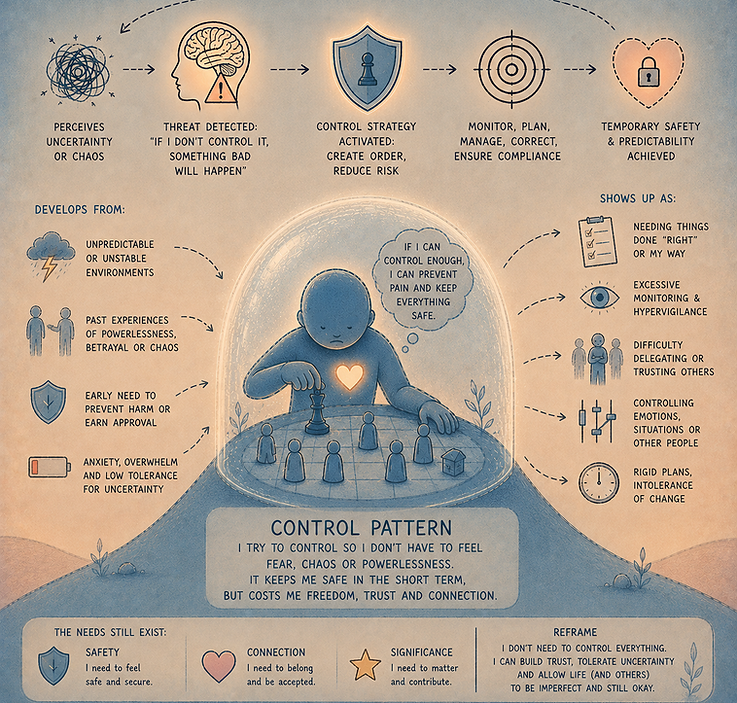
What is Control as a Pattern ?
Control is a cognitive and behavorial pattern where you create safety through rigid structure, anticipation, and management. You may feel compelled to plan, organize, direct, or oversee people and situations to reduce uncertainty and prevent things from going wrong.
It's perfectly natural and human to want to influence our environment.
The issue isn't the presence of the need for certainty itself — it's when control becomes chronic: when it operates at a frequency, intensity, and rigidity that makes letting go feel impossible regardless of how trustworthy the situation actually is.
When this pattern is active, unpredictability can feel threatening. You may struggle to delegate, become tense when others act differently than expected, or feel responsible for keeping everything on track. Control can feel like competence or leadership, while in fact your nervous system remains braced and on alert.
The cost is often rigidity, strained relationships, and a constant background tension. Relaxation and trust seem to be out of reach. Over time, control doesn’t eliminate anxiety — it relocates it.
If you're asking yourself "do I have control issues?", common signs include:
You have difficulty delegating or trusting others to handle things without constant monitoring
You need to know and oversse details, plans, and outcomes in advance
You tend to micromanaging projects or relationships
You feel anxiety when things don't go according to plan
You have difficulty adapting to unexpected changes
You feel responsible for making sure everything turns out right
If you're noticing that you tend to micromanage situations, or if your responses involve tightly organising circumstances to prevent potential problems, know that this pattern can be transformed.
If these signs don't match your experience, you can go back to choose another pattern that feels more aligned.
Understand Control: A Protective Pattern
When your pattern is active, it's rarely about deliberately seeking power or choosing to micromanage — rather, you are using an unconscious strategy to secure important human needs.
Your nervous system has learnt — often implicitly — that control is the most effective or safest way to preserve predictability.
When past experiences of unpredictability have been painful or threatening to your sense of safety, worth, agency or belonging, your brain stored these events as warning signals in your implicit memory. Later, when any situation feels uncertain or out of hand, your brain raises those flags quickly and your nervous sytem activates an automatic response. Your protective instinct to organise and manage kicks in before you've consciously chosen to.
At a time when letting go meant risking failure or being hurt, when being in charge was the only way to ensure things would be okay, when tight control was simply the most reliable path to safety — your nervous sytem used this pattern to protect you.
And because at some point, and to some extent, this pattern worked, over time these responses became like automatic safeguards you implement whenever uncertainty arises.
Think of it like having an internal weather forecaster who has experienced too many storms — trying to control every variable might not be the most peaceful response, but if it's the only way you've known to prevent perceived disasters, you'll keep using it until you learn better ways to handle life's uncertainties.
Understanding this pattern as a learned survival strategy rather than an inherent flaw shifts the question from "Why am I like this?" to "What was this protecting me from?" — and that reactivates your power to change.
What Causes the Control Pattern?
Your controlling reactions are not signs of looking for power or being fundamentally domineering or perfectionist. This pattern developed at the meeting of two forces: your external conditions that made unpredictability feel dangerous, and an inner capacity for anticipating problems, organising complexity, and holding things together under pressure.
If you grew up in an environment where chaos, unpredictability, or emotional instability were common, letting things unfold naturally might immediately trigger old fears of catastrophe. Or perhaps you were praised for being highly responsible, gradually learning to associate control with competence and worth. Instead of feeling and sitting with the vulnerability associated with uncertainty, you may automatically default to managing every variable as a way to create an illusion of predictability.
Control patterns typically develop when:
Your environment felt chaotic, unpredictable, or unsafe
Trusting others led to disappointment, betrayal, or things falling apart
Being in charge was the only way to ensure things would be okay
Uncertainty or lack of preparation felt threatening or overwhelming
Letting go meant risking failure, chaos, or being hurt
The control pattern, at its core, is an intelligent adaptation — evidence of a capable, forward-thinking mind finding ways to create order and prevent harm while navigating real uncertainty.
But while controlling behaviour may have once helped you feel secure or potent, it keeps you in a constant state of hypervigilance, believing that if you don't manage everything, things will fall apart — and it gradually erodes the trust that fulfilling relationships depend on.
A Shield Against Unpredictability
This pattern is not just a behaviour but a set of carefully designed shields: beliefs, thought patterns and behaviours that reinforce one another. They guard you against difficult feelings such as uncertainty, powerlessness, vulnerability, or chaos.
At its core, control is a strategy to avoid facing uncertainty itself.
Life contains ambiguity, change, mistakes, risks, and outcomes that cannot be fully predicted. Yet uncertainty requires trust in our ability to adapt if things go wrong.
At a time when your support system was limited — because of your age, dependence on others, emotional immaturity, difficult circumstances, or lack of coping skills — those possibilities could have felt genuinely threatening: "What if things don't go as planned?".
The goal of the pattern was to keep you within a range of outcomes your nervous system believed it had the resources to navigate. Without sufficient confidence in your ability to adapt, your nervous system chose to preserve continuity. It did so by learning to plan, monitor, organize, anticipate, and control variables wherever possible.— anything that reduced the possibility of disruption, overwhelm, rejection, loss, or change that uncertainty might brought.
Like all protective patterns, control developed as an attempt to solve a real problem with your available capacities and resources at the time. It created a greater sense of predictability and safety in situations where the consequences of letting go felt too uncertain, too overwhelming, or too difficult to navigate.
Immediate Relief but Delayed Consequences
Control often brings immediate relief.
By planning, monitoring, organizing, anticipating problems, or managing outcomes, you temporarily reduce uncertainty and create a sense of safety.
The difficulty is that our brain is much better at detecting immediate relief than delayed consequences. Because the relief is felt today, the brain interprets the strategy as effective and reinforces it. But life remains inherently unpredictable. The costs often emerge later through chronic stress, rigidity, burnout, relationship tension, and reduced adaptability when reality inevitably deviates from the plan.
The pattern therefore creates a powerful illusion: it feels protective because it creates certainty now, while quietly reducing your resilience in the face of uncertainty.
The Hidden Costs of Controlling Behavior
When faced with uncertainty or others' independence, your first impulse is likely to tighten your grip - to maintain your sense of safety and predictability. The immediate relief you feel might make you consider your control pattern as security, but it often comes at a cost to your peace and relationships. Others might feel stifled and withdraw, leading to a maze of resistance and exhausting power struggles.
When you're constantly in this hypermonitoring state, your ability to experience joy and spontaneity becomes limited, creating a vicious cycle of anxiety and rigidity.
The costs of maintaining this pattern often include:
Strained relationships → Constantly trying to manage others can make them feel suffocated, leading to pushback or emotional distance.
Exhaustion and stress → Carrying the burden of control is mentally and emotionally draining.
Frustration and disappointment → Since life is inherently unpredictable, trying to control everything often leads to repeated frustration.
Lack of true connection → Relationships based on control prevent the natural flow of mutual understanding, trust, and respect.
Unability to let go and appreciate the present moment → The underlying fear of trusting others or the unknown prevents you to fully enjoy what is happening in the present and the positive surprises life brings.
Impaired self-trust → The more you rely on control, the less confidence you develop in your ability to adapt, recover, or remain okay when things don't go according to plan. Safety starts to depend on managing reality rather than trusting yourself to navigate it.
Narrower, more fragile life → The energy spent anticipating risks, managing outcomes, and reducing uncertainty is not available for exploration, spontaneity, creativity, or deep engagement with life. Over time, your world becomes more predictable, but also narrower and less resilient.
Reinforcing effect → Because you rarely give yourself the opportunity to discover that you can adapt and recover, uncertainty continues to feel dangerous, making control increasingly difficult to let go of.
Ironically, the very strategy designed to create safety often prevents you from developing genuine resilience. When every uncertainty becomes something to eliminate, there are fewer opportunities to discover your ability to adapt, improvise, recover, and grow. Life becomes increasingly narrow, rigid, and mentally exhausting as more and more energy is devoted to maintaining an impossible level of predictability.
Control trades adaptability for predictability. The more resources are allocated to making reality conform to your expectations, the fewer remain available to build the capacities that would make uncertainty tolerable.
Ultimately, control doesn’t create real security—it creates rigidity, anxiety, and emotional exhaustion.
The Deeper Cost: Losing Contact with Reality
Perhaps the deepest cost of the control pattern is that it gradually distances you from reality — both external reality and your internal reality.
Externally, the need to control often prevents you from seeing life as it actually is: complex, uncertain, and only partially predictable. By constantly planning, monitoring, organizing, anticipating, or trying to influence outcomes, you may create the impression that enough preparation can eliminate uncertainty. Yet many of life's most important events — other people's choices, unexpected opportunities, illness, failure, success, love, or loss — remain fundamentally beyond your control. By focusing your energy on controlling outcomes, you avoid important information about what is actually controllable and what is not.
Internally, the control pattern often requires disconnecting from your own vulnerability. Feelings such as uncertainty, fear, helplessness, disappointment, grief, or lack of control become difficult to tolerate. Rather than acknowledging them, your attention shifts toward solving, organizing, anticipating, or preventing. Over time, it becomes increasingly difficult to recognize when your drive for control is no longer serving your goals, but simply protecting you from uncomfortable emotions.
This distance from reality comes at a significant cost. Good decisions depend on accurately distinguishing what you can influence from what you cannot. When those two become blurred, enormous amounts of time and energy may be invested trying to control situations, people, or outcomes that ultimately lie outside your influence, while neglecting the areas where your actions could genuinely make a difference. Rather than building a life around adaptability, flexibility, and wise action, life gradually becomes organized around reducing uncertainty wherever possible.
Reality rarely becomes more controllable simply because we try harder to control it. More often, uncertainty eventually reasserts itself through unexpected changes, setbacks, mistakes, or circumstances beyond our influence. When it does, people are often left not only with the distress they were trying to avoid, but also with the regret of opportunities not taken, experiences postponed, relationships over-managed, creativity restricted, and years spent preparing for life rather than fully living it.
The control pattern moves you onto a life trajectory shaped more by the pursuit of certainty than by the pursuit of what truly matters. The pattern was built to protect you from uncertainty, but it often ends up making uncertainty feel even more threatening while limiting the flexibility and resilience that would allow you to navigate it.
How to Foster Letting Go Without Losing Protection
Healing a Control Pattern isn't about abandoning all structure or pretending we don't need any influence over our lives. That would only activate your defenses and reinforce the pattern. Rather, it's about understanding your reactions better and recognizing when your past experiences might be coloring your present responses to uncertainty, and gradually developing new ways to respond that better serve your peace while honoring your need for healthy organization.
It is possible to keep all the valuable qualities your detail-oriented nature brings - your ability to plan effectively, your care for quality outcomes, your capacity for organization - while letting go of the parts that create rigidity. It's like transforming a tightly closed fist into an open, capable hand - not losing your ability to hold things, but doing so with more flexibility and grace.
But simply deciding to "let go" often doesn't work - you need to build new capabilities for handling uncertainty comfortably and for adapting and recovering in case of adverse events.
This understanding shifts you from self-criticism ("I need to stop being so controlling") to curiosity ("What would help me feel secure enough to loosen my grip?").
Tolerating Uncertainty and Vulnerability
One of the deepest capacities missing beneath the control pattern is the ability to remain present when certainty is no longer guaranteed.
It is not possible to find a way to plan well enough to eliminate uncertainty. Healing comes from gradually developing the confidence that, whatever happens, you will be able to cope.
Many people continue to navigate life as if they still possessed the limited resources, dependence, and vulnerability they had when the pattern first developed. Yet as adults, you often have significantly more emotional skills, autonomy, support, experience, and capacity to adapt than your nervous system realizes. And even where those capacities are still incomplete, they can be developed.
The difficulty is that the control pattern rarely allows those discoveries to happen. By continually shielding yourself from uncertainty, you also shield yourself from discovering your own resilience. You never fully experience that you can adapt when plans fail, recover from unexpected setbacks, or navigate situations you could never have predicted.
Also, uncertainty contains more than risk. It also contains possibility.
Many of life's most meaningful experiences cannot be planned in advance. Deep relationships, creativity, personal growth, unexpected opportunities, moments of joy, and even discovering strengths you never knew you possessed all require entering situations whose outcomes cannot be fully controlled.
Protective patterns narrow the range of possible outcomes until life becomes increasingly predictable—but also increasingly constrained. They reduce painful surprises, but they also reduce positive ones. In trying to eliminate uncertainty, we often unknowingly eliminate spontaneity, curiosity, creativity, and opportunities whose potential benefits far outweigh their manageable risks.
Healing is therefore not about abandoning planning or becoming reckless. It is about becoming wiser in where certainty is truly needed and where uncertainty is worth embracing. Some uncertainties are unnecessarily harmful and deserve to be reduced. Others are the natural price of growth, intimacy, creativity, learning, and a meaningful life. As your confidence grows, so does your willingness to engage with life as it is rather than trying to eliminate its uncertainty.
Resilience is not built by making life predictable. It is built by building the concrete capacities that allow you to navigate whatever life brings., allowing yourself to remain open to possibilities whose rewards may be far greater than your nervous system currently imagines.
How this journey works
Every protective pattern develops because, at some point, it became the best way your nervous system had to meet your fundamental needs: safety, connection, self-worth, or agency.
Those needs are essential. The problem is that the pattern often becomes your nervous system's main—or only—strategy for meeting them.
As a result, your options become increasingly narrow. Your well-being depends on keeping the pattern alive.
This journey is designed to change that.
Rather than trying to eliminate the pattern, you'll gradually develop the emotional, cognitive and relational capacities that expand your range of possible responses.
You'll learn to recognise what is happening inside you, regulate your nervous system, understand your emotions and needs, question your limiting beliefs, communicate more effectively, care for yourself, ask for support, accept reality, and act from your values.
As your range expands, you become able to meet your needs through many different strategies rather than relying on a single protective one.
That flexibility is what resilience looks like.
Over time, your nervous system no longer needs the pattern as much because it has many other ways to keep you safe, connected, effective, and grounded.
The capacities that make the pattern less necessary
This controlling pattern wasn't a mistake - it was probably the best strategy your nervous system had to protect you at the time, in the absence of other resources.
As you progress through this journey, your nervous system will learn that there are many different ways to stay safe, connected, valued, and individuated, and the capacities below will gradually emerge.
Recognising when fear drives control → The ability to notice the moment organising, planning, or managing tips into over-control — when your need to arrange outcomes is less about genuine preparation and more about managing the anxiety that arises when life feels unpredictable or unsafe.
Accurate intuition and inner compass → Developing the emotional awareness to distinguish between a genuine need for structure and your nervous system's automatic grasping response to uncertainty — so that your read of a situation reflects what is actually needed rather than what your anxiety is urging you to manage.
Values-based decision making → Knowing what matters most, what you stand for, and what your authentic principles are, so that your choices can be guided from the inside rather than driven by the compulsion to control outcomes — staying anchored in who you are rather than in what you try to prevent.
Resilience and self-trust → Building the inner confidence that even if things go wrong, plans fall apart, or others don't meet your expectations, you will be okay — that your sense of self is solid enough to survive chaos and disappointment, and that you do not need to control everything in order to stay safe.
Staying grounded amidst unpredictability → The ability to remain present and regulated when circumstances feel uncertain or out of hand — so that your nervous system's alarm doesn't collapse your capacity to respond flexibly. It will increase your trust that not everything needs to be managed in advance.
Emotional vocabulary for honest expression → The ability to name your fears, anxieties, and need for reassurance without externalising them as control — so that what you actually feel can be expressed directly rather than managed indirectly through over-organisation or micromanagement.
Trust in life's natural unfolding → The capacity to release your grip on outcomes and allow situations, relationships, and people to develop in their own way and time — discovering that life's unpredictability is not only survivable but often the source of its richness.
Influencing without dominating → The ability to contribute your perspective, share your needs, and shape your environment through honest communication and collaboration rather than through control — discovering that genuine influence is built on trust and mutuality, not on managing every variable.
Why It’s Worth the Work
Transforming controlling behavior into trust, flexibility, and emotional balance will allow you to experience relationships that feel more peaceful, authentic, and connected. Instead of feeling tense, responsible for everything, or exhausted from managing every detail, you will create space for ease, self-trust, and mutual respect.
Most importantly, this journey reconnects you with the deep inner knowing that you are safe, even without control.
The work is not to become someone who stops planning or abandons responsibility. It is to become someone who can stay close enough to reality—the limits of your control, the uncertainty of life, and your capacity to adapt—even when outcomes cannot be guaranteed.
Staying present through uncertainty, unpredictability, and imperfection is a capacity that can be learned, practiced, and strengthened over time.
Let's begin this journey together.
Awareness: The First Step Toward Change
The journey begins with simply noticing - when the need to control visits, what invites it in, and how it moves through you. By gently exploring what's driving your controlling reactions - what you're really trying to protect yourself from - you can begin to develop more conscious choices in how you respond to life's inherent unpredictability.
This curiosity opens a space between a trigger and your response, allowing you to choose actions that align more closely with who you want to be, building relationships based on trust and shared power rather than control and resistance.
You don't need control to feel safe. By becoming aware of your pattern, you can transform control into trust, flexibility, and ease.

Ready to Build Your New Capacities?
To start your journey please create a free account.
This version is free, your experience helps us refine it. Feedback is welcome !
No payment, no spam, you can stop anytime.
We’ll start this journey by identifying the situations that tend to activate your protective pattern.
From our blog:
For a different angle on this pattern — why letting go feels like free-falling, the loop that makes your grip tighter over time, and what your need for control is actually protecting — read Why You Need to Control Everything.
