
Why You Need to Control Everything — And Why Letting Go Feels Like Free-Falling
- Mar 24
- 9 min read
Updated: Jun 29
You've checked the plan three times. You've thought through every scenario — what could go wrong, who might drop the ball, where the weak points are. You've sent the follow-up message. You've reorganised the spreadsheet. You've mentally rehearsed the conversation you need to have tomorrow, mapping out their possible responses and your counter-moves.
And still, something doesn't settle. There's a hum of tension underneath everything — a low-grade vigilance that never fully switches off. Even when things are going well, part of you is scanning for the thing that's about to go wrong. Because something always does. And when it does, you need to be ready.
People call you organised. Reliable. A natural leader. And you are all of those things. But underneath the competence is something nobody sees: the quiet terror of what would happen if you'd stop holding it all together. The fear that if you loosen your grip — on the project, the relationship, the plan, the outcome — everything will collapse. And that this time, you won't be able to fix it.
You've tried to let go. People keep telling you to. But "let go" feels like "free-fall into chaos with no parachute." And your nervous system would rather die of exhaustion than risk that drop.
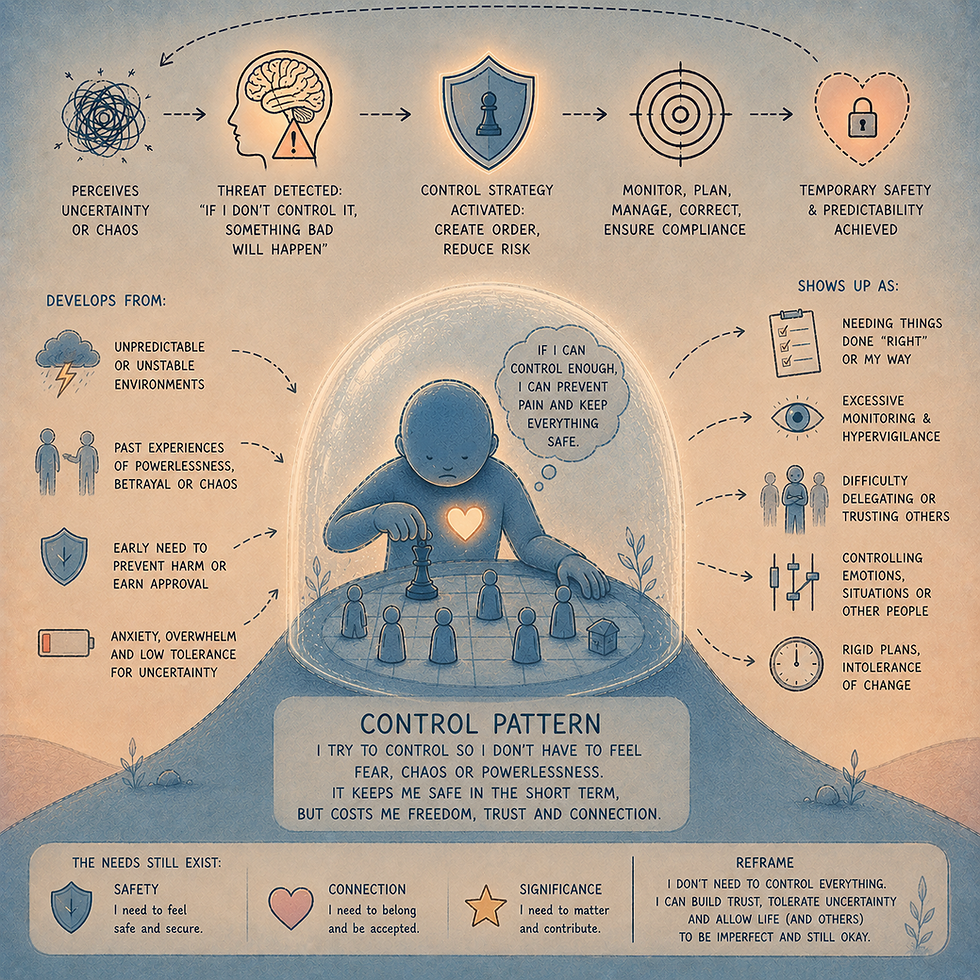
Control Isn't About Power — It's About Survival
Most people misread control. They see someone who micromanages, who can't delegate, who needs to know every detail — and they assume it's about ego. About power. About not trusting others. But in fact,it's about making the world predictable enough to survive in.
When your nervous system learned — usually early — that unpredictability meant pain, it developed a logical response: eliminate uncertainty.
If you can anticipate every variable, plan for every contingency, manage every person's behaviour — then nothing can blindside you. Nothing can hurt you the way it did before.
This isn't a personality trait. It's a threat management system. The same circuitry that would have you scanning for predators in the wild has you scanning for risks in your calendar, your relationships, your team's performance. It doesn't distinguish between a genuine emergency and a colleague who does things differently than you would.
Both register as: something is out of my control, and that's not safe.
The cost isn't visible from the outside. From the outside, you look like someone who has it together. From the inside, you're running an entire surveillance operation — and the operator never gets a day off.
This constant vigilance has a biological cost. Your prefrontal cortex — the part of your brain responsible for planning, decision-making, and self-regulation — is the most energy-expensive region you have. Running it at full capacity all day, every day, without rest, is why controllers often feel mentally depleted even when nothing has gone wrong. For the neuroscience behind this exhaustion, read The Prefrontal Cortex: Your Brain's Wisdom Center.
The Trade-Off Your Brain Made
Every child needs both safety and flexibility — the ability to feel secure AND the capacity to handle surprise, disappointment, and things not going as planned. In a stable enough environment, both develop together. You learn that the world is mostly predictable, and that when it isn't, you can cope.
But when the environment was chaotic, unstable, or punctuated by sudden loss — when unpredictability meant a parent's mood shifting without warning, or a family situation collapsing overnight, or promises being made and broken — the child's brain made a trade-off.
Controllers typically traded flexibility for predictability.
The child learned: if I can manage what happens, I don't have to feel what happens. If I stay ahead of every situation, nothing can catch me off guard. If I'm the one holding everything together, at least I know it won't fall apart.
Sometimes this looked like becoming the responsible child — the one who managed the household's emotional temperature, who anticipated the parent's needs, who became the adult before they were ready.
Sometimes it looked like perfectionism — if everything I do is flawless, nothing bad can happen.
Sometimes it looked like becoming the family's problem-solver — the one everyone turned to, because you were the one who could make things work.
In all cases, the brain encoded a deep equation: control = safety, uncertainty = danger. Not "uncertainty is uncomfortable" — that's manageable. But "uncertainty is where catastrophe lives, and I cannot afford to be unprepared for catastrophe."
When the stakes feel existential, over-preparation isn't neurotic. It's rational.
The problem is that the equation never updates. The child who needed to control a chaotic home becomes the adult who needs to control a stable one — a partner, a team, a dinner plan, a holiday itinerary. The grip doesn't loosen because the grip was never about the specific situation. It was about how uncertainty feels like in your body. And that feeling hasn't changed.
The Loop That Keeps You Stuck
The trade-off would be manageable if it stayed contained. But control creates a self-reinforcing cycle that escalates with time.
It works like this: You take control of a situation — you plan, you manage, you oversee. The situation goes well. Your nervous system registers: see, control works. The equation is confirmed. But you never get to discover what would have happened if you hadn't controlled it.
Maybe it would have gone fine anyway. Maybe someone else would have handled it. Maybe the imperfect outcome would have been survivable.
You'll never know — because you prevented the experiment from running.
This means your nervous system accumulates evidence that control is necessary, and never accumulates evidence that it isn't. The dataset is entirely one-sided. Every success reinforces the belief: without my management, this would have fallen apart. Even when that's objectively untrue.
Meanwhile, the costs pile up invisibly. You're never actually here.
Not from lack of attention — you're hyper-attentive. But your attention is always one step ahead: anticipating what's next, calculating what could go wrong, rehearsing how you'll handle it. You're in the future, managing scenarios that haven't happened yet.
The present moment — the one where your child is telling you about their day, where your partner is trying to connect, where the meal is warm and the evening is quiet — passes through you unregistered. Your system can't land in the present because the present is uncontrolled territory. Only the future can be managed.
Your relationships strain under the weight — and what they produce looks like proof that you're right. The people around you — partners, colleagues, children — feel your control. In your actions — the micromanaging, the checking, the redoing — and also in your energy underneath: the tension, the vigilance, the restless hum of something could go wrong. That stress doesn't stay contained in your body. It radiates. And the people who absorb it react in ways that confirm everything your nervous system believes.
Your partner becomes nonchalant or disengaged — not because they don't care, but because they've learned there's no point trying when you'll redo it anyway.
Your children push harder against the boundaries — not because they're out of control, but because the pressure of being managed makes rebellion the only available form of autonomy.
Your colleague stops bringing their best — because initiative in a controlled environment feels futile.
And what you see when you look at them is exactly what your system predicted: people who can't handle things correctly without you.
The nonchalant partner confirms: they'd let everything fall apart.
The boundary-testing child confirms: chaos is always one step away.
The disengaged colleague confirms: nobody cares as much as I do.
Every reaction your control produces becomes evidence that your control is necessary — but you can't see that you produced the reaction. The tension came from you. The stress was yours. And the behaviours you're now managing are, in large part, the behaviours your management created.
And here's the deeper trap: your self-worth becomes fused with your ability to keep things running.
When your identity is built on being the competent one, the reliable one, the one who holds it together — then any moment of letting go feels like a threat to who you are, not just to the outcome. Being present without an agenda feels pointless. Delegating feels irresponsible. Trusting feels reckless. Because if you're not the one managing everything, who are you?
This is where control stops being a strategy and becomes a cage.
You can't be present because presence means accepting what is, without managing it.
You can't connect deeply because connection requires vulnerability — the willingness to not know how things will go.
And you can't grow because growth requires exactly what your system can't tolerate: stepping into the unknown without a plan.
This is one of the most uncomfortable truths about the control pattern: the very strategy you use to keep things together may be the thing preventing the people around you from growing — and preventing you from seeing your situation clearly. For a deeper exploration of why we distort reality to protect ourselves, and what it costs, read The Hard Truth: Why Seeing Reality Clearly Is the Foundation of Good Decision-Making.
Why "Just Let Go" Doesn't Work
and why you still need to control everything
The advice is always some version of: relax, trust the process, you don't have to do everything yourself.
But telling a controller to "let go" is like telling someone to step off a cliff and trust that the ground will appear. Your body refuses — because it has a decades-old memory of what happens when you're not in charge, and that memory says: disaster.
Willpower can force you to delegate once. To leave the plan unfinished. To not send the follow-up message. But the anxiety floods in immediately, and it doesn't subside — it escalates. Your mind generates worst-case scenarios. Your body tenses. You check your phone compulsively. And eventually you step back in, because the cost of the anxiety exceeds the cost of just doing it yourself.
This isn't failure of will. It's your nervous system doing exactly what it was designed to do: protecting you from what it learned is dangerous.
The issue isn't that you won't let go. It's that your system genuinely believes that letting go is how things fall apart. This is why you still need to control everything.
What Actually Needs to Change
Control points directly to what was never built — the capacities that would make uncertainty survivable without the grip.
Tolerating not knowing: This is the foundation. The ability to sit with uncertainty — to genuinely not know how something will turn out — without the anxiety becoming unbearable. Not pretending you're fine with it. Actually building the nervous system capacity to remain regulated while the outcome is unknown. This is a physiological skill before it's a mental one.
Distinguishing preparation from anxiety management. Planning is useful. Over-planning is self-medication. Learning to recognise the point where organising stops serving the outcome and starts serving your anxiety is what allows you to keep the useful parts of your nature while releasing the compulsive ones.
Allowing others to do things their way. This isn't about accepting lower standards. It's about recognising that your way isn't the only viable way — and that the rigidity of "it has to be done exactly like this" isn't about quality. It's about the nervous system's inability to tolerate a process it didn't design. Relationships where one person dictates the outcome aren't partnerships — they're dictatorships with good intentions.
Surviving outcomes you didn't choose. This is the core. The controller's deepest fear isn't that things will go badly — it's that things will go differently than planned and they won't be able to handle it. Your nervous system's prediction is that uncontrolled situations lead to catastrophe. The only data that updates this prediction is lived experience: moments where you loosened your grip, the outcome wasn't what you designed, and you were okay — sometimes even better off. Each one recalibrates the equation slightly. Over time, "not what I planned" stops meaning danger and starts meaning life.
Recognising the full range of your control strategies. Control doesn't always look like taking charge. Sometimes it looks like subtle manipulation — steering conversations, managing information, engineering situations so people "freely" choose what you wanted them to choose. Sometimes it looks like emotional pressure — guilt, withdrawal of affection, implied consequences. The more sophisticated the strategy, the harder it is to see as control. But if the underlying motivation is I cannot be okay unless this goes a specific way, it's the same pattern — regardless of how elegantly it's executed.
These are capacities, not personality changes. They develop through practice. And they're available to any nervous system willing to discover that the world it feared — the one where chaos returns the moment you loosen your grip — may no longer be the world you're living in.
The capacities that transform control — tolerating uncertainty, allowing imperfection, resting without guilt — are the same capacities whose absence creates invisible ceilings across your entire life. For a deeper look at how missing skills constrain far more than you realise, read Why You Keep Hitting the Same Ceiling — The Missing Skills Nobody Taught You.
Control Rarely Travels Alone
If you recognise yourself in this article, you'd probably recognise yourself in some adjacent patterns too. Control often sits alongside defensiveness (if being wrong threatens the competent identity you've built), overfunctioning (if doing everything yourself is how you ensure it's done right), and conflict avoidance (if you manage situations preemptively to prevent the disagreements you'd rather not have).
These aren't separate problems. They're different expressions of the same underlying dynamic: a nervous system that equates unpredictability with danger, and never got the lived experience of uncertainty followed by being okay.
Take the Patterns Quiz → It takes about 10 minutes and maps which protective strategies are most active in your life right now — not as diagnoses, but as signals pointing to the exact capacities that need development.
Read the full Control Pattern guide → For a deeper exploration of how this pattern forms, what it costs, what skills it points to, and how transformation actually works.
The Adventure Within is a self-guided personal development platform grounded in neuroscience, evolutionary psychology, and attachment research. We help people identify their protective patterns and build the specific capacities that make those patterns unnecessary — so change doesn't require constant effort, but becomes your natural way of responding.


Comments