
Understand and Overcome Overactive Anger
Are you often asking yourself "why am I so angry?" or noticing you react with intense irritation to small triggers?
Understanding what causes your pattern—and recognizing its costs—is the first step toward overcoming it.
Overactive anger doesn't develop randomly. It often emerged to protect you in difficult situations, at a time when you didn't yet have the resources to respond differently — and it has been reinforced ever since.
10 to 20 minutes a day to build the capacities that will make this pattern unnecessary
No payment, no spam, you can stop anytime.
What is Overactive Anger?
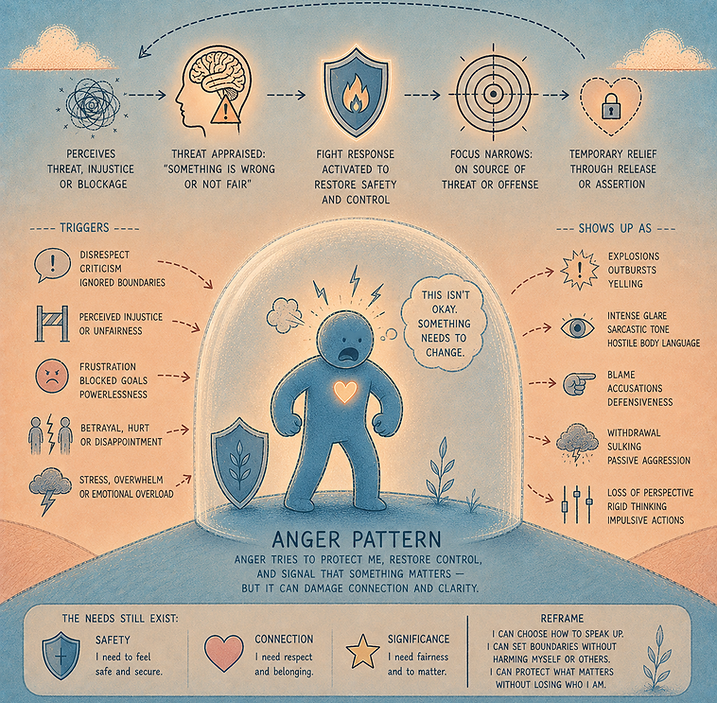
Overactive Anger is a cognitive and behavorial pattern where you quickly moves into irritation, defensiveness, or confrontation. You may react strongly to perceived injustice, incompetence, intrusion, or loss of control. Tension rises fast, your words come out sharply, and your body prepares for impact — even when the situation might not objectively require that level of force.
You may be experienced as intense, reactive, or intimidating, or you may pride yourself on being direct, honest, and unwilling to tolerate nonsense. But underneath, your nervous system stays on high alert, scanning for threats and preparing to push back before being hurt, overpowered, or disrespected.
It's important to note that it's perfectly natural and human to feel angry sometimes.
The issue isn't the presence of anger itself — it's when reactivity becomes chronic: when it operates at a frequency, intensity, and rigidity that makes measured response feel impossible to access regardless of the actual threat.
The cost of overactive anger is often relational rupture, regret, chronic tension in the body, and a shrinking range of emotional responses, where anger becomes the fastest — and sometimes only — way to deal with discomfort. Over time, overactive anger doesn’t create safety — it exhausts it.
Common Signs
If you're asking yourself "do I have an anger problem?", common signs include:
Quick irritation or explosiveness over small things
Difficulty calming down once triggered
Using anger to establish any boundary or create distance
Feeling powerful or in control when angry
Where Overactive Anger Comes From
Overactive anger reactions are not signs of fundamentally being a bad person or being unable to self-control. Your pattern likely emerged at the meeting of two forces: external conditions that made vulnerability feel dangerous, and your inner capacity for mobilising intense energy.
It usually develops in environments where expressing softer emotions like sadness or fear was discouraged or unsafe. Your nervous system learned to automatically default to anger as a way to stay protected and maintain agency. Now exposing your more vulnerable side might immediately trigger old fears of being hurt or dismissed.
Overactive Anger: A Protective Pattern
Like all protective patterns, overactive anger developed as an attempt to solve a real problem with your available capacities and resources at the time. Exposing more vulnerable feelings such as sadness, fear, helplessness, disappointment, shame, or grief creates uncertainty and a temporary loss of control. Anger, by contrast, creates energy, clarity, and direction.
At a time when your support system was limited — because of your age, dependence on others, emotional immaturity, difficult circumstances, or lack of coping skills — the question "What if I feel vulnerable?" could have felt genuinely threatening. Overactive anger, at its core, is an intelligent adaptation. When the consequences of exposing your softness felt too uncertain, too overwhelming, or too difficult to navigate, it kept you safe and connected. It was probably the best strategy your sharp, energetic mind had to protect what mattered to you. And because at some point, and to some extent, this pattern worked, it got reinforced over time: these reactions became automatic paths you follow when feeling stressed, threatened, or unheard.
What Anger Costs You
Immediate Relief but Delayed Consequences
The behaviours generated by the pattern often brings immediate relief.
By moving quickly into anger, your nervous system temporarily escapes feelings of fear, sadness, helplessness, shame, or vulnerability.
The Hidden Costs of Overactive Anger
When feeling hurt or threaten by someone, your first impulse is likely to push back or lash out - to release that surge of emotion and to regain a sense of power. The immediate relief you feel might make you consider your overactive anger as letting out steam, but it often comes at a cost to your relationships. The other person, feeling attacked, might start hiding their true feelings or needs, leading to a maze of misunderstandings and deeper hurts.
When you're constantly in this protective, angry state, your body releases stress hormones that can affect your physical health, creating a vicious cycle of heightened reactivity and stress.
The costs of maintaining this pattern often include:
Eroded trust → When anger becomes your dominant mode of expression, others may feel unsafe or unsure how to approach you.
Unresolved issues → Your explosive reactions often push others away, leaving the root of the conflict unaddressed.
How to Change
Foster Vulnerability Without Losing Protection
Pushing your anger down or pretending it doesn't exist would only activate your defenses and reinforce the pattern. Bottling up anger is like trying to hold a beach ball underwater - it takes enormous energy and eventually, it's going to pop up somewhere. Instead, the way to change starts with understanding your reactions better and recognizing when your past experiences might be coloring your present reactions. Then you can gradually develop new ways to respond that better serve both your need for protection and fairness and your relationships.
It is possible to keep all the powerful qualities anger brings - your clarity about what matters to you, your courage to stand up for yourself, your energy to face challenges - while letting go of the parts that cause harm.
The Capacities that make the Pattern Less Necessary
As you progress through this program, your nervous system will learn that there are many different ways to stay safe, connected, valued, and individuated, and the capacities below will gradually emerge:
Recognize early warning signs → The ability to notice the first signs of your activation rising — the tension, the heat, the narrowing of perception — before they build into a reaction that overshoots the situation and leaves you feeling out of control or regretful.
Accurate intuition and inner compass → Develop the emotional awareness to distinguish between a genuine boundary violation and your nervous system's automatic response to any discomfort — so that your read of a situation reflects what is actually happening rather than what past hurt conditioned you to expect.
Values-based decision making → Know what matters most, what you stand for, and what your authentic principles are, so that your responses can be guided by who you want to be rather than driven by the intensity of what you feel in the moment.
Why It’s Worth the Work
Transforming overactive anger into constructive emotional expression is one of the most liberating gifts you can give yourself and your relationships. It will allow you to build trust, resolve conflicts effectively, and connect with others on a deeper level. By learning to understand and express your emotions with assertiveness but without violence, you create space for mutual understanding, healing, and growth.
Most importantly, this journey reconnects you with your more vulnerable part, and allow you to receive the messages sent by your sadness, your fears, your doubts, behind the discomfort.
How this journey works
Every protective pattern developed because, at some point, it was the best way your nervous system had to meet your fundamental needs: safety, connection, self-worth, or self-realization. Those needs are essential.
The problem is that the pattern gradually became your nervous system's main—or only—strategy for meeting them.
This journey is designed to change that.
Rather than trying to eliminate the pattern, you'll gradually develop the emotional, cognitive and relational capacities that expand your range of possible responses.
You'll learn to recognise what is happening inside you, regulate your nervous system, understand your emotions and needs, question your limiting beliefs, communicate more effectively, care for yourself, ask for support, accept reality, and act from your values.
As your range expands, you'll become able to meet your needs through many different strategies rather than relying on a single protective one.
That flexibility is what resilience looks like.
Over time, your nervous system no longer needs the pattern as much because it has many other ways to keep you safe, connected, effective, and regulated.
The program is free from start to finish. Plan on 10 to 20 minutes a day; the whole journey takes about 3 to 6 months, depending on your pace.
Awareness: The First Step Toward Change
The journey begins with simply noticing - becoming aware of when your anger steps in, what invites it in, and how it moves through you. By exploring what's driving your angry reactions - what you're really trying to protect yourself from - you can begin to develop more conscious choices in how you respond to life's challenges.

From our blog:
For a different angle on this pattern — why anger is standing in for every emotion you were never allowed to feel, the loop that leaves you surrounded by compliance but starved of connection, and why anger management misses the point entirely — read Why You Lash Out.