
Why You Push People Away — The Hidden Logic Behind Your Fear of Intimacy
Updated: Sep 22
You like them. You might even love them. And yet the moment things start to feel real — the moment they want to know you, not the curated version but the actual you — something inside pulls the emergency brake.
Maybe you pick a fight over nothing. Maybe you get suddenly busy. Maybe you go quiet for days without understanding why. Maybe you find a flaw in them that conveniently justifies pulling back — they're too needy, too intense, too much.
From the outside, it looks like you don't want closeness.
From the inside, the truth is more painful: you want it desperately. You just can't seem to stay in the room when it arrives.
If you've ever wondered why you keep ending up alone despite genuinely wanting connection, the answer isn't that you're broken or incapable of love.
The answer is that your nervous system learned — long before you had any say in the matter — that closeness is where you get hurt.
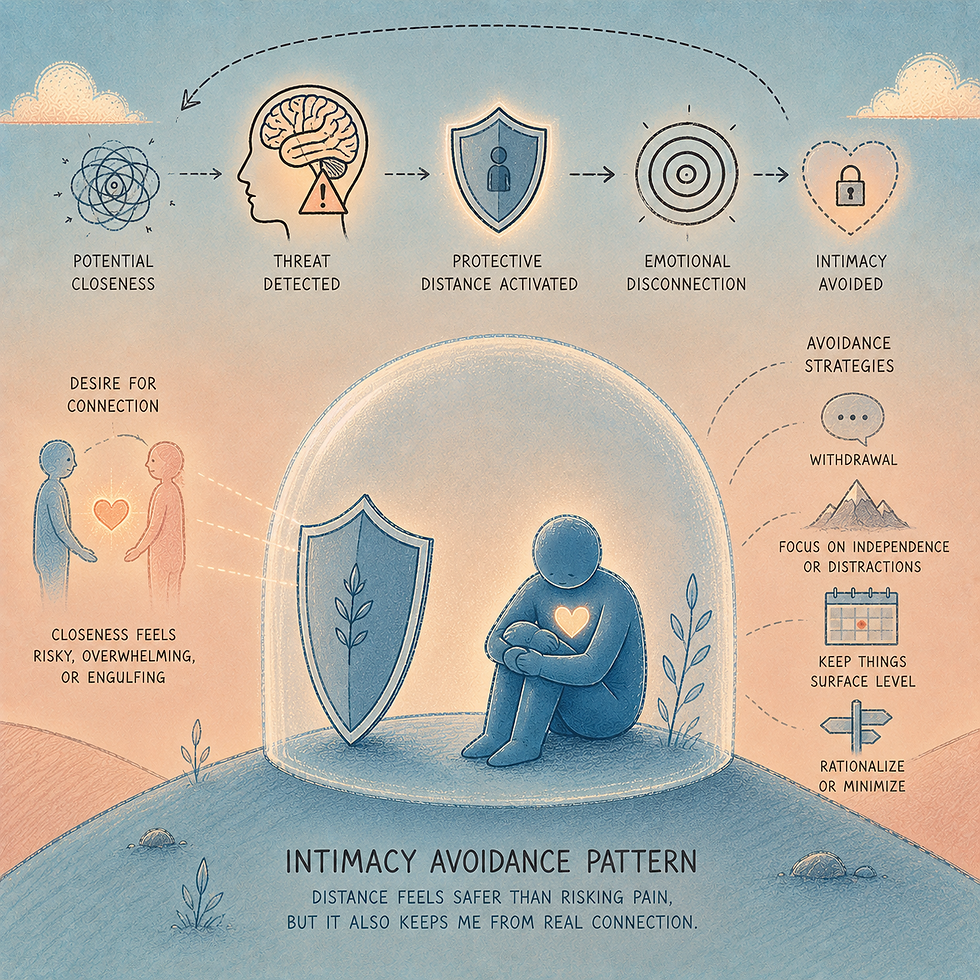
The Trade-Off Nobody Remembers Making
Every child needs both connection and autonomy — to feel close to others AND to feel like a separate, intact self.
In a good-enough environment, those two needs coexist. You can be close without losing yourself. You can be yourself without losing the relationship.
But when the environment makes those needs compete — when closeness came with engulfment, intrusion, betrayal, neglect or emotional chaos — the child's brain faces an impossible choice. And it makes a trade-off.
Intimacy avoiders typically traded connection for autonomy.
The child learned: if I need people, I get hurt. If I let them see me, I lose control. If I stay self-contained, I stay safe.
This is the mirror image of emotional dependency. The emotionally dependent person sacrificed autonomy and authenticity to keep connection. The intimacy avoider sacrificed connection to keep the self intact.
Different strategies, same impossible situation: an environment where you couldn't have both.
That trade-off was intelligent.
A child who experienced that vulnerability leads to pain should build walls.
A child whose emotional needs were met with dismissal or exploitation should stop showing them.
Building the fortress was smart and adaptative. The problem is that you're still living in it — decades later, in relationships that are nothing like the ones that made it necessary.
These trade-offs aren't random — they're shaped by how the brain develops in childhood. The neural circuits for emotional regulation, self-expression, and social safety are built through interaction with caregivers. When those interactions teach the child that loss of self is the price of love, the brain wires accordingly — and those circuits become the default operating system for decades.
For more information behind this process, read How Brain Development Shapes Our Inner World.
Why You Can't "Just Be More Vulnerable"
The standard advice for intimacy avoidance is some version of: open up, let people in, be more vulnerable. As if the only thing standing between you and deep connection is a decision you haven't made yet.
But you have made that decision. Probably many times. And every time, the same thing happens: you open up a little, it feels exposing, your system floods with discomfort, and you retreat — often so smoothly that the other person barely notices the door closing.
That's because intimacy avoidance is a threat response your nervous system is running. The same circuitry that would make you pull your hand from a hot stove makes you pull back from emotional closeness. It fires before conscious thought. It doesn't check whether this person is safe. It checks whether this experience matches the pattern — and the pattern says: closeness is where you get hurt.
Willpower can't override this. You can't think your way into feeling safe. And forcing vulnerability when your system is screaming danger doesn't build intimacy — it builds a more sophisticated version of the same wall, one that looks open on the surface while keeping everything real at arm's length.
This is why you can be in a relationship for years and still feel unknown.
Why you can talk for hours without saying anything that matters.
Why you can perform closeness — dinner together, holidays together, even living together — while the essential you remains behind glass. The proximity is real. The intimacy isn't.
Want to see which protective patterns may be shaping this in your own life?
Take the free Protective Patterns Quiz →
The Loop That Deepens the Fear of Intimacy
The initial trade-off — protect autonomy at the cost of connection — creates a self-reinforcing cycle that tightens over time.
You keep people at a safe distance. Because they never get close enough to truly know you, you never get the experience of being known and safe.
Without that experience, your nervous system has no evidence that closeness is survivable. So the belief that intimacy is dangerous remains unchallenged — and the distance stays.
Meanwhile, the distance has a cost you don't immediately see: your emotional muscles atrophy. The ability to sit with tender feelings, to tolerate being seen, to stay present when things get complex — these are capacities that develop through practice. And you've been practising the opposite: withdrawal, containment, emotional self-sufficiency. You've gotten extraordinarily good at being alone. And less and less good at being with.
So when you do try to let someone in, it feels overwhelming. Not always because the other person is too much, but because your capacity to handle emotional closeness has narrowed from disuse. The window of what feels tolerable has shrunk. A conversation that a securely attached person would experience as intimate, you experience as flooded.
This creates a secondary belief that reinforces the pattern powerfully: relationships are exhausting. And for you, they genuinely are — but not because connection is inherently draining. It's because your nervous system is working overtime.
Every interaction requires managing the alarm system (this is too close), suppressing the withdrawal reflex (don't run), monitoring the other person's emotional state (are they about to need something from me?), and maintaining the performance of presence while your body is screaming to create distance.
That's not connection. That's surveillance. No wonder you're depleted after an evening with someone who cares about you.
And here's the cruellest turn of the cycle: the people who could love you and respect your autonomy eventually stop trying.
The emotionally healthy, securely attached people — the ones who could actually offer the safe connection you need — interpret your distance as lack of motivation. They respect it and move on.
The ones who stay are often the opposite: emotionally dependent people whose need for closeness is as intense as your need for autonomy. They pursue while you retreat. They ask for more while you shut down. They cling while you suffocate. And every interaction confirms exactly what your nervous system believed all along: closeness = engulfment, other people's needs = overwhelm, intimacy = losing yourself. Not because intimacy is actually like that — but because you've self-selected into the one dynamic that makes it feel that way.
When you hear securely attached people describe relationships as energising, replenishing, or restful, it sounds like a foreign language. Your lived experience is the opposite: relationships cost energy. Being alone restores it.
So the logical conclusion seems obvious — I'm just someone who needs a lot of space.
But the truth is more specific: you need a lot of space because your system doesn't know how to be close without flooding. The issue isn't how much energy connection requires. It's that your system is spending all its energy on defence instead of on the connection itself.
And there's a quieter secondary effect that's easy to miss: the people who do stay in the long run eventually conform to your unspoken rules. They learn the boundaries you never explicitly set: don't ask too many personal questions, don't expect emotional availability, don't request reciprocity you won't receive. The relationship organises itself around your terms. On the surface, this looks like a connection that works for you — low-maintenance, respectful of your space, comfortable. But what it actually is, is a relationship emptied of the very things that would make it nourishing: mutual vulnerability, emotional exchange, the experience of being known and knowing someone in return. You live in relationships that never threaten you — but never feed you either. And you draw the conclusion: relationships just don't give me much. The conclusion is accurate. But it's your pattern that created the condition.
Over time, the loneliness that comes with the fear of intimacy becomes a familiar ache — something you've learned to live with so thoroughly that you almost mistake it for preference. "I'm just independent", "I don't need much from people", "I'm fine on my own".
These aren't lies exactly. But they're not the whole truth either. They're the stories your nervous system tells to justify a fortress it built when you were seven.
For a deeper look at the blocks to connection, read : Why You Struggle To Make Friends.
What Actually Needs to Change
The fortress was a brilliant solution to a real problem. But the problem has changed — and the fortress hasn't.
What needs to change isn't your personality or your need for space. Those are real.
What needs to change is the automatic equation your nervous system runs:
closeness = danger, vulnerability = loss of self, needing someone = getting hurt.
That equation doesn't update through insight. You can understand exactly why you avoid intimacy and still do it. It updates through new experiences that your nervous system can't explain away — small, repeated moments of being seen and surviving it.
The specific capacities that make this possible:
Recognising the withdrawal reflex before it completes. Not after you've gone silent for three days. In the moment — when you feel the first pull toward distance, the sudden urge to change the subject, the instinct to find a flaw. That fraction of a second between the trigger and the retreat is where choice lives. Widening it is the first skill.
Staying present with intimate feelings without shutting down. Tenderness, longing, need, gratitude — these are the emotions intimacy avoiders have the hardest time with. The ones that make you feel exposed. Building the capacity to let them exist without immediately managing them through distance is what makes closeness survivable.
Expressing your need for space without severing connection. Most intimacy avoiders know only two modes: close or gone. The skill is learning a third: "I need some space right now, and I'm not going anywhere." Communicating your limits in a way that the other person experiences as honesty rather than rejection changes the entire dynamic.
Tolerating being known. Actually letting someone see the parts you've kept hidden — the needs, the fears, the softness beneath the self-sufficiency — and discovering that being seen doesn't destroy you. This doesn't happen all at once. It happens in small doses, with safe people, at a pace your nervous system can integrate.
Distinguishing real danger from old signals. Your alarm system treats all closeness as threatening because it was trained on closeness that was. Learning to tell the difference between a genuinely unsafe person and a nervous system echo from twenty years ago is what allows you to lower the drawbridge selectively — not for everyone, but for the people who have earned it.
These are capacities, not personality changes. They develop through practice. And they're available to any nervous system willing to update its data — no matter how long the fortress has been standing.
For a deeper look at how undeveloped skills create self-imposed limitations across every area of life, read Why You Keep Hitting the Same Ceiling — The Missing Skills Nobody Taught You.
Intimacy Avoidance Rarely Travels Alone
If you recognise yourself in this article, you'd probably recognise yourself in some adjacent patterns too.
Intimacy avoidance often sits alongside conflict avoidance (if disagreement feels like it will accelerate the closeness you're trying to manage, silence becomes the default) and passive-aggressiveness (if you can't express frustration directly without inviting the very emotional intensity you're trying to avoid, it leaks out sideways — through withdrawal, sarcasm, or quiet non-cooperation). Control often appears too (if managing everything means never being caught off guard emotionally), as does overfunctioning (if being helpful keeps the relationship functional without ever becoming personal).
These aren't separate problems. They're different expressions of the same underlying dynamic: a nervous system that learned closeness costs more than it gives, and never got the lived experience of safe vulnerability to prove otherwise.
Take the Patterns Quiz → It takes about 10 minutes and maps which protective strategies are most active in your life right now — not as diagnoses, but as signals pointing to the exact capacities that need development.
Read the full Intimacy Avoidance guide → For a deeper exploration of how this pattern forms, what it costs, what skills it points to, and how transformation actually works.
The Adventure Within is a self-guided personal development platform grounded in neuroscience, evolutionary psychology, and attachment research. We help people identify their protective patterns and build the specific capacities that make those patterns unnecessary — so change doesn't require constant effort, but becomes your natural way of responding.
Want to go beyond understanding and start building those capacities?


Comments