
Why You Can't Trust Anyone — And Why Your Hypervigilance Is Solving the Wrong Problem
- Apr 12
- 9 min read
Updated: Jun 29
Your partner tells you they're staying late at work, and before you've even replied, part of your mind is already constructing alternative explanations. Your colleague pays you a compliment, and you spend the next hour analysing what they might be positioning for. A friend cancels plans, and the surface-level "no worries" you text back has nothing to do with what's happening inside — which is a rapid, thorough scan of every recent interaction for signs you missed.
You don't want to be this way. You can see what it costs. The exhaustion of running a permanent background investigation on everyone in your life. The loneliness of never quite fully trusting anyont. The awareness that the people around you can feel it — the testing, the holding back, the way you're always half-present because the other half is monitoring.
But you can't stop. Because the one time you let your guard down — the one time you trusted without scanning — that's when it happened. Whatever "it" was. The betrayal, the deception, the moment you realised that the person you believed in wasn't who you thought they were. And your nervous system made a permanent note: never again.
Here's the problem: "never again" is a promise your nervous system can't keep without destroying everything else you need.
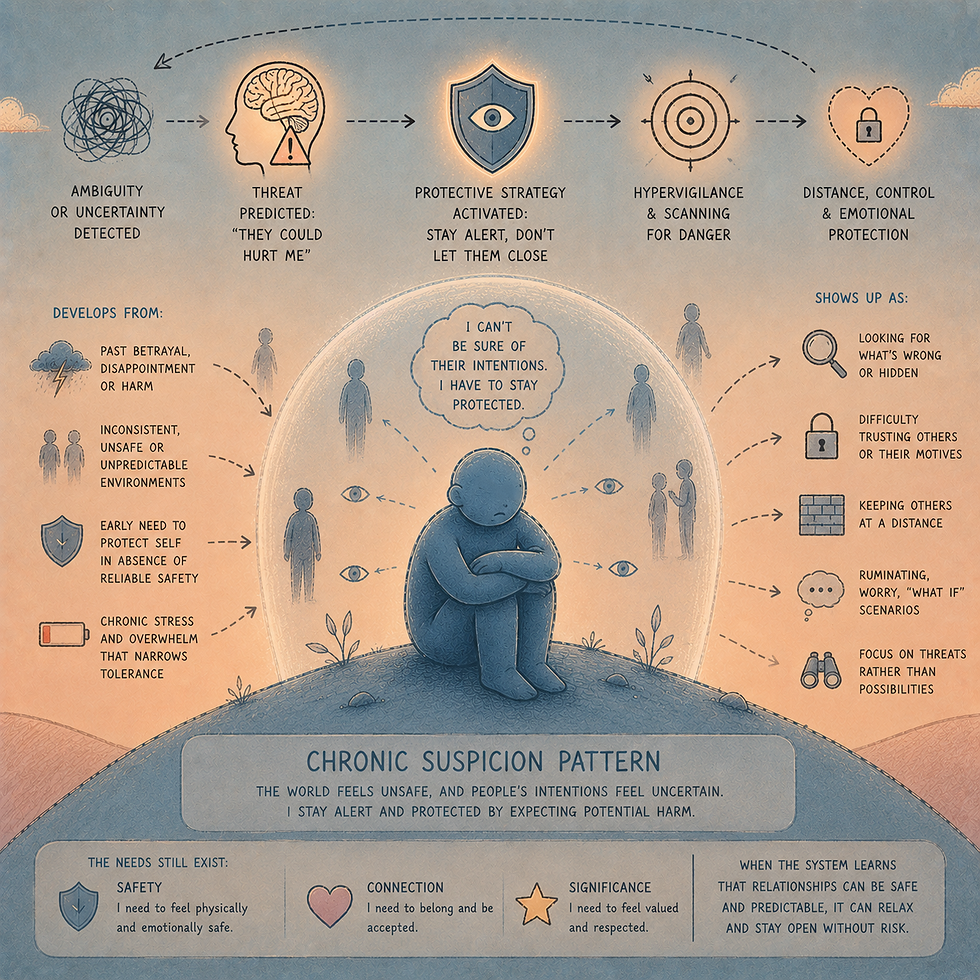
Suspicion Isn't Paranoia — It's a Detection System Running in Overdrive
Chronic suspicion lives in your nervous system's threat-detection architecture — the same system that scans for predators, evaluates strangers, and calculates social risk. In someone with a history of betrayal, that architecture is functioning at maximum capacity, all the time, on every interaction, with zero distinction between a genuine red flag and a neutral data point.
Your brain doesn't analyse situations and then decide to be suspicious. It starts with suspicion before the analysis is complete. By the time you're aware of the interaction, the verdict is already in: something isn't right here. Then your thinking brain goes to work finding the evidence to justify what the alarm already decided. It will always find some, because no human behaviour is perfectly unambiguous. There's always a gap, a possible alternative reading, a thread to pull.
This is why rational reassurance doesn't help. You can look at the evidence and agree that there's no reason to distrust this person — and still feel the suspicion in your body. It's a state your nervous system enters when it detects any of the patterns it associated with past betrayal. And those patterns are everywhere, because the detection system's sensitivity has been turned up to maximum.
The Trade-Off Your Brain Made
Every child needs to be able to trust AND to protect themselves.
In a reliable environment, both capacities develop together: you learn to trust because trust is generally rewarded, and you learn to detect genuine danger because the baseline of safety makes real threats stand out clearly.
But when the environment was deceptive — when the people who were supposed to be safe turned out not to be, when words didn't match actions, when reality was manipulated or denied — the child's brain faced a problem. Trust led to pain. Openness led to exploitation. Taking things at face value led to being blindsided.
People with chronic suspicion typically traded openness for vigilance.
The child learned: the only way to avoid being hurt is to see it coming. If I can detect the lie before it lands, if I can read the real motive beneath the stated one, if I can stay one step ahead — then nobody can catch me off guard again.
This might have looked like a parent who said one thing and did another — who promised safety and delivered chaos, who expressed love and then weaponised it. Or a family where information was currency — where things were hidden, narratives were managed, and the "official story" rarely matched what you could feel in the room. Or a betrayal later in life — a partner, a friend, an institution you believed in — that shattered a trust you'd assumed was solid and rewired your system permanently around the question: how did I not see that coming?
In all these cases, the nervous system extracted the same conclusion: trust is where you get ambushed. Not "trust requires discernment" — that's healthy. But "trust itself is the vulnerability that gets exploited." When the equation is that absolute, vigilance becomes the only acceptable mode. And your mind becomes extraordinarily good at finding evidence for what it already believes: that something, somewhere, isn't what it seems.
The Loop That Keeps You Watching
The initial trade-off — openness sacrificed for vigilance — creates a self-reinforcing cycle that intensifies over time.
It works like this: You enter a relationship — any relationship — already scanning. You monitor for inconsistencies, test for hidden motives, hold back emotionally until you've gathered enough data to assess whether this person is safe. The other person, sensing that they're being evaluated rather than trusted, responds in one of two ways.
Some people try harder — becoming more transparent, more accommodating, more eager to prove themselves. But their eagerness itself triggers your alarm: why are they trying so hard? What are they hiding? Genuine warmth, interpreted through the filter of suspicion, looks like manipulation.
Others pull back — sensing the scrutiny, feeling that they can't be natural around you, they create distance. And their withdrawal confirms exactly what your system predicted: see, they weren't trustworthy. The moment I looked closely, they retreated.
Either way, your suspicion is confirmed. You never accumulate the one kind of data that would update the equation: the experience of trusting someone and having that trust honoured over time. Because you never fully extend trust. You offer a provisional, conditional, revocable version of trust — and then interpret the other person's natural imperfections as evidence that even that was too much.
And your holding back has a consequence you don't see: it shapes how people treat you. Because you're never fully present — always monitoring, always testing, always in partial reserve — people sense that they are under scrutinity. Even when they can't name what's happening, they notice something is off when you ask questions you already know the answer to, or when you don't avoid sharing information.
And nobody behaves naturally under examination and distrust. They become cautious, guarded, slightly off — not because they're hiding something, but because being tested feels like a trap. Their discomfort shows up as hesitation, inconsistency, or withdrawal — exactly the signals your detection system was scanning for. The test produces its own evidence. You conclude: They failed, I was right not to trust them. But what failed was the conditions, not the person.
Over time, the vigilance consumes resources that should be going to connection.
Every conversation has a surface layer (what's being said) and a monitoring layer (what's really going on). You're running both simultaneously, all the time. This is why relationships feel so exhausting — not because people are draining, but because you're doing double the cognitive work of everyone else in the room. You're having the conversation AND auditing it. No wonder there's nothing left for pleasure, spontaneity, or ease.
And something subtler happens to your perception itself. When you scan for deception long enough, you start to see it even where it doesn't exist. Not because you're irrational, but because your detection system has been calibrated on genuine betrayal and now treats ambiguity as threat. A partner who pauses before answering isn't thinking — they're concealing. A friend who changes the subject isn't shifting naturally — they're deflecting. A colleague who disagrees with you isn't offering perspective — they're positioning against you. The system doesn't distinguish between signal and noise anymore. Everything is signal.
The loneliest part: you know this is happening and you can't stop it. You can see yourself scanning. You can feel the suspicion arriving before the evidence justifies it. You may even recognise that the person in front of you has done nothing wrong. But your alarm doesn't answer to logic. It answers to pattern — and the pattern says: the last time you trusted, it cost you everything.
Why "Just Trust More" Doesn't Work
and why you can't trust anyone
The advice always sounds the same: give people the benefit of the doubt, stop assuming the worst, let your guard down.
But you can't let down a guard you're not consciously holding up. Chronic suspicion isn't a policy you've chosen. It's an automatic orientation your nervous system adopted when the alternative — openness — proved catastrophic. Asking you to "just trust" is asking you to voluntarily re-enter the exact state where you were most profoundly hurt.
Willpower can suppress the vigilance temporarily. You can decide to trust and white-knuckle your way through a dinner, a weekend, even a month. But the scanning continues beneath the surface — and every ambiguous data point accumulates until the dam breaks. Often spectacularly. Often at the worst possible moment. Often directed at the person who least deserves it, who has been patient and consistent and was finally beginning to feel safe — until your system decided they must be the most dangerous of all, precisely because they'd gotten close.
What needs to change is the equation your nervous system runs: openness = ambush, trust = vulnerability, vulnerability = devastation. Until that equation is updated with new experiential data, no amount of good intentions will override it.
What Actually Needs to Change
Chronic suspicion is a signal pointing to specific capacities that never had the chance to develop — because the vigilance made them unnecessary.
Distinguishing pattern from evidence.
Your detection system is exquisitely sensitive — but it was calibrated on a biased dataset. It learned what betrayal looks like from specific people in specific circumstances, and now it applies those templates everywhere. Learning to ask "is this actually suspicious, or does it match an old pattern?" is the skill that separates discernment from hypervigilance. Not dismissing your instincts — interrogating their source.
Tolerating the vulnerability of not knowing.
Suspicion's deepest function is to eliminate uncertainty. If I can figure out what they're really thinking, I'm safe. But you can never fully know another person's motives. Learning to sit with that irreducible uncertainty — to tolerate not having the complete picture — without the anxiety becoming unbearable is what makes trust possible. Not blind trust. Trust with eyes open and feet on the ground.
Letting evidence accumulate over time.
Trust isn't a binary — you don't flip a switch from suspicious to trusting. It builds incrementally, through small tests met with consistent responses. Extending a small vulnerability and seeing it honoured. Sharing something real and watching what they do with it. The skill isn't trusting all at once. It's trusting in doses your nervous system can integrate — and letting the data build a new prediction, slowly.
Releasing the shame of having been deceived.
This is the one nobody talks about — and it may be the one driving the vigilance most powerfully. Beneath the fear of being betrayed again is often a deeper fear: the fear of being the fool. The one who didn't see it coming. The one who trusted when they shouldn't have. There's a quiet, corrosive belief that being deceived reflects on your intelligence — that the person who gets played is somehow the stupid one. But that equation is backwards. The moral failure belongs to the person who deceived, not to the person who trusted. Openness isn't naivety. Trust isn't gullibility. Someone who exploits your trust has revealed something about their character, not about your intelligence or worthiness. As long as being deceived feels like a verdict on your worth rather than a reflection of someone else's integrity, your system will do anything — including destroying every relationship in its path — to make sure it never happens again. Unhooking shame from the experience of betrayal is what allows trust to become a choice you make with open eyes, rather than a humiliation you must prevent at all costs.
Surviving betrayal without annihilation.
Here's the truth your system is working hardest to avoid: you might trust someone and they might let you down. Again. That possibility can't be eliminated. But you survived the last betrayal — you're here, you're reading this, you're functional. The question isn't whether you can prevent all future betrayal. It's whether your sense of self is sturdy enough to absorb it if it happens — without the entire system collapsing. Building that sturdiness is what makes trust a calculated risk rather than an existential gamble.
These are capacities, not personality changes. They develop through practice. And they don't require you to become naive, gullible, or blindly trusting. They require you to become discerning — which is a very different thing from being suspicious.
Chronic Suspicion Rarely Travels Alone
If you recognise yourself in this article, you'd probably recognise yourself in some adjacent patterns too. Chronic suspicion often sits alongside control (if managing every variable is how you prevent being caught off guard), intimacy avoidance (if the deepest trust feels like the deepest exposure), and defensiveness (if others' observations about you feel like strategic manoeuvres rather than honest feedback).
These aren't separate problems. They're different expressions of the same underlying dynamic: a nervous system that learned trust is where you get ambushed, and never accumulated enough experiences of safe vulnerability to update that conclusion.
Take the Patterns Quiz → It takes about 10 minutes and maps which protective strategies are most active in your life right now — not as diagnoses, but as signals pointing to the exact capacities that need development.
Read the full Chronic Suspicion guide → For a deeper exploration of how this pattern forms, what it costs, what skills it points to, and how transformation actually works.
The Adventure Within is a self-guided personal development platform grounded in neuroscience, evolutionary psychology, and attachment research. We help people identify their protective patterns and build the specific capacities that make those patterns unnecessary — so change doesn't require constant effort, but becomes your natural way of responding.


Comments