
Why You Can't Stop People-Pleasing — And Why "Just Say No" Doesnt Work.
Updated: Sep 22
You said yes again, even though you knew before the words left your mouth that you didn't want to. You felt it — the tightening in your chest, the quiet sinking feeling, the split second where the truth almost surfaced before something faster overrode it. But you smiled, and agreed, and added one more thing to a life already stretched thin.
Later, alone, you felt the familiar mix: exhaustion, resentment, and the creeping sense that you've disappeared into someone else's needs again. Maybe you told yourself what you always tell yourself — next time I'll say no. Next time I'll set a boundary.
But next time comes, and the same thing happens. Because people pleasing can hardly be overcame through willposer alone.
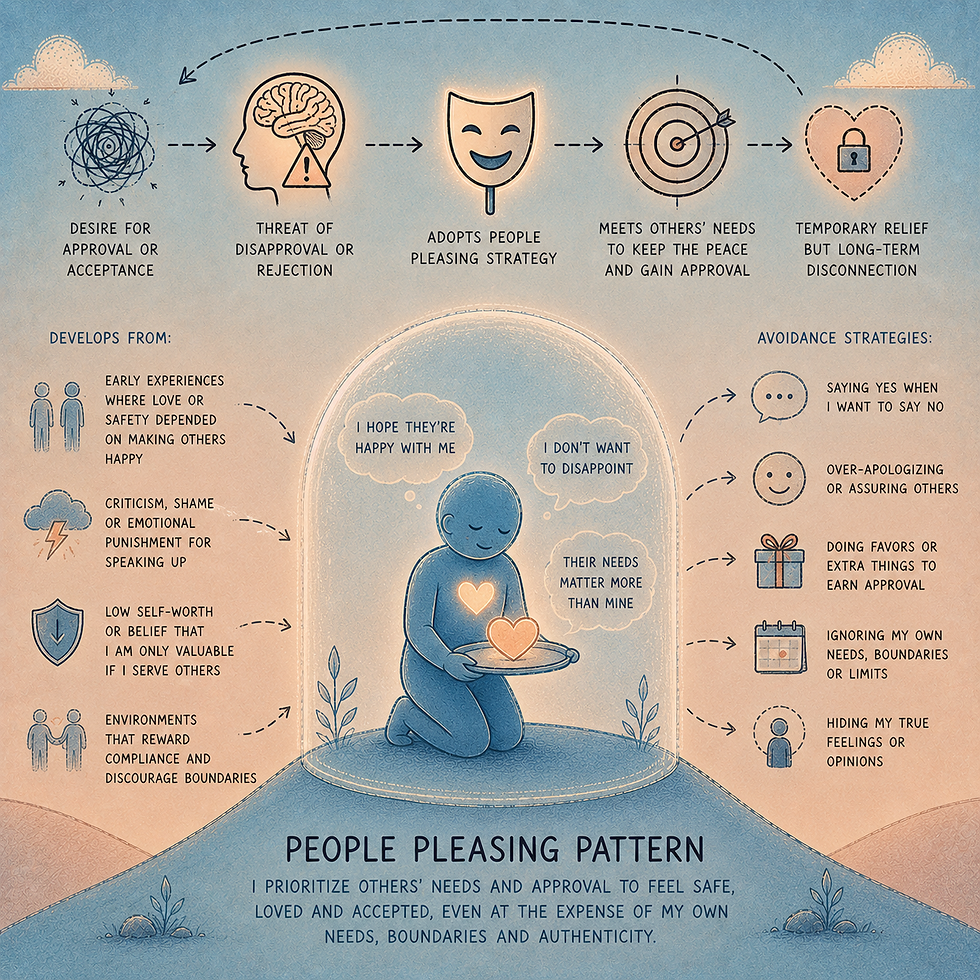
What People-Pleasing Actually Is
People-pleasing isn't just a bad habit. It's a protective strategy your nervous system built at a time when saying no felt genuinely dangerous — maybe not physically, but at least emotionally. Maybe love felt conditional on being helpful. Or approval required being agreeable. But basically, the safest way to maintain connection was to make yourself useful, pleasant, and small.
Often it started as a child, and at that time, that strategy was an intelligent adaptation, and probably the best you could do with the resources and capacities you had. It kept you close to the people you depended on. It reduced conflict in environments where conflict felt threatening. It earned you the belonging you needed to survive.
The problem isn't that you developed this strategy. The problem is that your brain never updated it. Decades later, your nervous system still runs the same programme: someone expresses a need, your alarm fires, and your mouth says yes before your mind has finished forming the sentence.
It can sometimes seems like weakness. In fact, your brain keeps doing what it once thought was the best strategy — in a context where it's no longer beneficial.
Why "Just Set Boundaries" Doesn't Work
and why you can't stop people pleasing from willpower only
The most common advice for people-pleasers sounds straightforward: learn to say no, set boundaries, put yourself first.
But if you've tried this, you know what happens. You gear yourself up, you rehearse the words, you even manage to say them — and then the flood hits. Guilt. Anxiety. The urgent conviction that you've just damaged the relationship irreparably. Your body feels like you've done something bad and dangerous, even when your rational mind knows you haven't.
That's because you're fighting your nervous system survival strategy.
When your brain encoded "accommodation = safety" in childhood, it filed that equation in the threat pathways of your nervous sytem, at a level that activates beneath conscious awareness, faster than thought. Trying to override that with willpower is like trying to override the reflex that pulls your hand from a hot stove. It just doesn't work.
Willpower lives in your prefrontal cortex — the rational, planning part of your brain. It's powerful but energetically expensive to run.
Survival strategies, such as people-pleasing, lives in your limbic system — the fast, automatic, survival-oriented part. In a contest between the two, the survival system wins almost every time. That's how brains are built.
This is why you can understand your people-pleasing perfectly, read every book about boundaries, agree with all of it intellectually — and still freeze when your colleague asks you to take on extra work, or when your partner's tone shifts.
Insight without capacity changes almost nothing. To be able to do something different requires giving your nervous sytem other means to ensure your emotional survival. You can do so by building the specific skills, capacities and resources your nervous system never had the chance to develop.
The Trade-Off Your Brain Made
Every human needs safety, connection, self-worth, and autonomy. When a child's environment can't support all four — when expressing autonomy threatens connection, or when aproval seems available only through usefulness — the brain sacrifices one need to protect another.
People-pleasers typically traded authenticity for connection.
The child learned: if I suppress what I want and become what they need, I get to stay close. If I say what I really think, I risk losing them.
That trade-off made perfect sense at the time. But it has a cost that compounds over decades:
You gradually lose access to your own preferences.
After years of asking "what do they want?" before "what do I want?", the second question starts returning blank. You genuinely don't know what you prefer — because the system that tracks your preferences has been silenced for so long it's gone quiet.
Resentment builds silently. You give and give, and something inside keeps a ledger. Your needs aren't disappearing because you're ignoring them. They're accumulating.
Your relationships become conditional without you realising. You can't know if you are valued for your easiness — the flexibility, the accommodation, the emotional labour — or for who you are. And somewhere you sense this, which makes the prospect of stopping even more terrifying. If I stop being convenient, what's left?
This is the trap: the pattern that was supposed to protect connection actually prevents the kind of connection you long for — one where you're known and valued for who you are, not for how accomodating you are to others.
Want to see which protective patterns may be shaping this in your own life?
Take the free Protective Patterns Quiz →
The Loop That Keeps You Stuck
What makes people-pleasing so persistent isn't just the original trade-off. It's the self-reinforcing cycle that deepens the pattern with every repetition.
It works like this:
You silence your needs to maintain connection.
Because your needs go unexpressed, you gradually lose contact with what they even are.
The less you know yourself, the more hollow you feel inside — and the more you depend on other people's approval and closeness to feel like you exist.
Which makes connection feel even more essential. Which makes the cost of risking it feel even higher.
Which makes you silence your needs more thoroughly.
Each turn of the cycle tightens the trap. The resentment grows. The exhaustion and hollowness deepens.
And more fundamentally: you start losing track of who you are outside of how agreable and convenient you are to others.
Your identity becomes the accommodation itself — the helpful one, the easy-going one, the one who holds everything together. When someone asks what you want, the honest answer is increasingly "I don't know". You start to see yourself as someone indecisive, without strong identity besides your accomodation, which makes it even more necessary to avoid disappearing.
This is where people-pleasing stops being just a relational pattern and becomes something closer to a loss of self.
At some point, you don't feel like you're suppressing your needs — you've just lost reliable access to them. And without that access, "just say no" is meaningless advice. Say no to what? On behalf of whom? You can't set boundaries around needs you can't feel.
And the cycle has a vicious secondary effect: it also shapes who stays close to you. Your constant accommodation attracts — and retains — the people who benefit most from it: those who don't like inconvenience, who don't tolerate a "no" easily, who have grown accustomed to you managing, adjusting, absorbing. The people who would respect your boundaries, who would welcome your honesty, who would prefer the real you to the accommodating version — some of them drift away, because the relationship lacks the substance that mutual honesty creates. Over time, your relational environment gets filled with people to whom saying no is more difficultand seems even more dangerous. Which confirms the belief that boundaries threaten connection. But actually, that belief is being confirmed by a reality your pattern has curated.
This is also why the pattern gets worse under stress. When life gets harder, you need more of your time and energy for yourself — to cope, to recover, to handle what's on your plate. But as you haven't built enough internal support, stress strongly activates the fear of losing the only support you have, which is external connection, at precisely the moment you can least afford to accommodate it. You need to say no more to protect your energy. But you're less able to say no than ever. So you stretch thinner, accommodate harder, and the gap between what you need and what you allow yourself widens — until something breaks.
One day, the pressure exceeds what even your system can contain. The months of overstepped limits, the accumulated resentment, the invisible ledger of everything you agrred on without being asked — it erupts. Maybe over something small. Maybe at the person who least deserves it. But what comes out isn't proportional to today's trigger. It's the backlog of everything you swallowed. The other person is stunned — from their perspective, everything was fine until it suddenly wasn't. And their reaction — the shock, the defensiveness, the withdrawal — confirms exactly what your nervous system predicted: see, expressing my needs and boundaries creates exactly the rupture I was trying to prevent. What the system can't see is that the explosion wasn't caused by the expression of the need — it was caused by months of suppression that turned a whisper into a detonation. The problem is not honesty, but the long silence that preceded it.
This exhaustion isn't just emotional — it's a resource problem. People-pleasers spend their finite energy, time, and attention on managing others' needs while running a permanent deficit on their own. Understanding how you actually allocate your resources — and where the imbalance sits — can make the invisible cost of people-pleasing suddenly very concrete.
What Actually Needs to Change
Understanding the loop reveals something important: people-pleasing isn't just a behaviour to stop. It's a system of missing capacities.
The child who traded authenticity for connection never got to develop the skills that would have allowed to meet both needs simultaneously.
The ability to listen to your own needs in real time.
The tolerance for someone else's disappointment.
The experience of being honest and still loved.
The autonomy to go your own way and have your need for connection go unmet for a little while.
Those capacities can't develop when your entire system is organised around accommodation — there's no room, no safety, no practice ground.
You can now build the capacities whose absence made the pattern necessary — so the situations your nervous system treats as threats gradually become situations it can navigate with choice.
The capacities that transform people-pleasing are concrete and learnable:
Recognising your own needs in real time — the ability to pause before responding and actually check in with yourself. Not after the fact, when the resentment arrives. In the moment, when the request is still hanging in the air.
Tolerating disapproval without collapsing. This is the big one. People-pleasing persists because your nervous system treats someone else's disappointment as a survival threat. Building the capacity to feel that discomfort — to let it be there without immediately fixing it — is what makes everything else possible.
Distinguishing genuine generosity from fear-driven accommodation. Not all giving is people-pleasing. The question is whether you're choosing to give from fullness or you're compelled to give from fear. Learning to tell the difference changes which "yes" you keep and which you release.
Expressing limits without over-explaining. People-pleasers tend to turn every "no" into an essay — justifying, softening, apologising. Learn to say no it cleanly, warmly, and without the implicit message that you've done something wrong by having a limit.
Staying connected through honesty. The deepest fear behind people-pleasing is that authenticity will cost you the relationship. Building the lived experience that honest relationships are more durable than accommodating ones — that people don't leave when you're real, they leave when they sense you're performing — is what finally loosens the pattern's grip.
These aren't personality changes. They're skills. And like any skill, they develop through practice.
People-pleasing is one of the clearest examples of how missing skills create invisible ceilings. The capacity to tolerate disapproval, to express limits without guilt, to stay connected while being honest — these aren't personality traits you either have or don't. They're skills that never had the chance to develop because your entire system was organised around accommodation. For a deeper look at how undeveloped skills create self-imposed limitations across every area of life, read Why You Keep Hitting the Same Ceiling — The Missing Skills Nobody Taught You.
People-Pleasing Rarely Travels Alone
If you recognise yourself in this article, you'd probably recognise yourself in some adjacent patterns too. People-pleasing often sits alongside conflict avoidance (if saying yes avoids tension), overfunctioning (if being indispensable feels like safety), or intimacy avoidance (if performing care is easier than receiving it).
These aren't separate problems. They're different expressions of the same underlying dynamic: a nervous system that learned to prioritise others' comfort over your own truth, and never got the chance to learn another way.
Take the Patterns Quiz → It takes about 10 minutes and maps which protective strategies are most active in your life right now.
Read the full People-Pleasing guide → For a deeper exploration of how this pattern forms, what it costs, what skills it points to, and how transformation actually works.
The Adventure Within is a self-guided personal development platform grounded in neuroscience, evolutionary psychology, and attachment research. We help people identify their protective patterns and build the specific capacities that make those patterns unnecessary — so change doesn't require constant effort, but becomes your natural way of responding.
Want to go beyond understanding and start building those capacities?


Comments