
Why You Can't Trust Your Gut Feeling Yet — And How to Fix Your Intuition
Updated: Apr 27
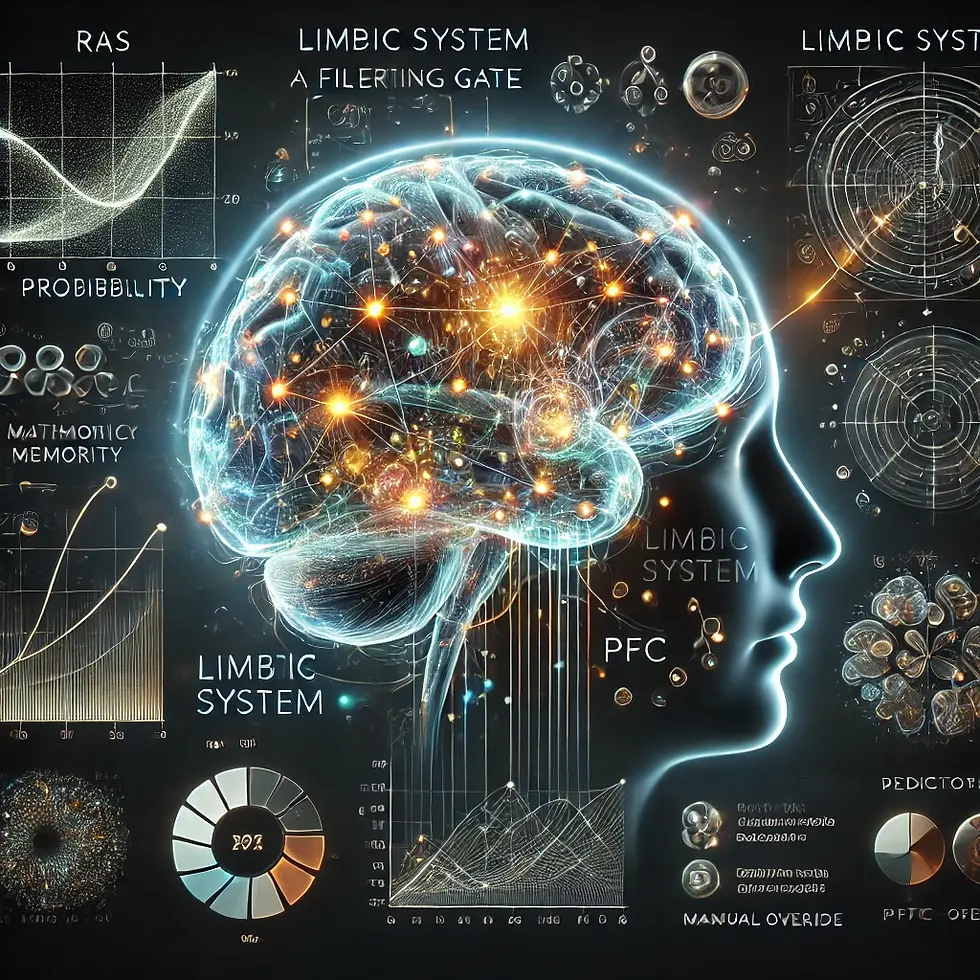
Your Intuition Isn't Broken — It's Running on Old Data
Most of us have learned to distrust our intuition. We live in a culture that prizes rational analysis, and somewhere along the way, the quiet signals coming from inside us started to feel unreliable — too subjective, too emotional, too hard to justify to others or even to ourselves.
So we override them. We think harder, weigh more options, ask more people. And sometimes we still can't decide — or we decide, and it doesn't feel right, and we don't know why.
What most people don't realise is that intuition isn't a mystical capacity some people have and others don't. It's a biological system — sophisticated, fast, and in many cases deeply accurate. The problem isn't that it's unreliable. The problem is that it's running on data that was collected a long time ago, in very different circumstances, by a much younger version of you.
Understanding how that system works — and why it sometimes leads you astray — is the first step toward being able to trust it again.
What intuition actually is
Your brain is a prediction engine. Every second, it's scanning your environment and calculating what's safe, what's risky, and what's worth pursuing — based on everything you've experienced before. It does this largely without your awareness, and far faster than conscious thought.
What we call "gut feeling" is pattern recognition. Your brain is running calculations in the background, matching current situations to past experiences and generating a response before you've had time to think. This isn't vague or mystical — it's your nervous system doing sophisticated probability assessments, the same way it would calculate whether to reach for something hot based on past experience of burns.
This system is extraordinarily efficient. But it has two fundamental problems.
The first is that it was built for a world that no longer exists. Your brain evolved to keep a hunter-gatherer alive — which means it treats social rejection as a survival threat, craves immediate rewards (food couldn't be stored back then), and approaches the unfamiliar with suspicion. These responses made sense tens of thousands of years ago. They're often counterproductive now.
The second problem is more personal: for most of us, past experiences of pain, fear, or scarcity have distorted the data the system runs on.
Your intuition isn't broken — it's doing exactly what it was designed to do. It's just working from faulty assumptions about what's dangerous, what you're capable of, and what's actually available to you.
How your brain builds its predictions
Three systems work together to generate intuitive responses.
The first is a filtering system.
Your brain receives an overwhelming amount of sensory information every second — far more than consciousness can process. So it filters, selecting only what seems relevant based on past experience. This happens before conscious awareness, which means your brain is already deciding what counts as important data before you've noticed anything.
The second is a pattern library
This is the part that stores memories and builds models of how the world works. It's fast and automatic, and it doesn't prioritise truth. It prioritises survival and predictability. When you "just know" something without knowing how, this is the system retrieving pattern matches too quickly for conscious thought to catch up. It's efficient, but it's not always working from accurate or current information.
The third is what you might think of as an override switch.
This is the slower, more energy-intensive part of your brain that can question the output of the pattern library and consciously update your models. This is the only part capable of real change. But because it requires significantly more energy than the automatic system, it tends to go offline under stress or exhaustion — exactly when you most need it.
How the data gets corrupted
Even the most sophisticated prediction system fails with corrupted data. Your brain's prediction engine suffers from specific problems that distort its calculations:
Childhood experiences carry disproportionate weight
Your brain formed many of its core predictions early in life, from a small number of experiences. A child who was rejected twice by peers conclude "social situations lead to rejection" — even if it doesn't make sense statistically, because our brains evolved to learn fast from limited examples. Early humans faced life-or-death learning scenarios where a child couldn't afford to encounter a predator twenty times before recognizing the danger pattern. Quick learning mattered more than accuracy. More problematic is that even several situations of being included won't erase the conclusion because our brain evolved to encode childhood experiences with extrapermanence, because skills for finding food or avoiding dangers shouldn't be easily forgotten.
The consequence is that a handful of childhood experiences can continue to dominate your predictions decades later, even when your adult life has provided abundant contradictory evidence. Your brain treats early data as more authoritative — not because it's more accurate, but because it was encoded when the prediction system was first being built, during a period the brain treats as foundational.
To understand exactly how this foundational period shapes your inner world, read How Brain Development Shapes Our Inner World.
Painful memories take up more space than they deserve
Emotionally intense experiences — moments of shame, fear, rejection, or failure — get encoded with much greater permanence than neutral ones. From an evolutionary standpoint this makes sense: remembering the place where you were attacked matters more than remembering the many times nothing happened.
The consequence is a mental database that dramatically overweights painful experiences. Someone who gave fifty comfortable presentations and three humiliating ones will often build their predictions primarily around those three — because those are the moments the brain flagged as survival-relevant and encoded in detail. The other fifty barely registered.
You're missing data from paths you never took
Your prediction system can only work with experiences you've actually had. Every situation you've avoided — because it felt too risky, too exposing, too likely to go badly — is a blank in your data. And your brain doesn't register it as missing information. It registers the absence of bad outcomes as confirmation that avoidance was the right strategy.
This creates a self-reinforcing loop: old predictions generate avoidance, avoidance prevents new data, and the absence of new data confirms the original prediction. The pattern sustains itself without ever being tested against reality.
Example: Sarah was humiliated speaking up in class as a child. As an adult, she avoids networking events and stays quiet in meetings. Because she never puts herself in these situations, she never collects data showing that professional environments respond very differently to middle school classrooms. Her career suffers from lack of visibility — which she reads as "I'm not good enough", rather than recognising she's operating from data collected at age twelve.
Why the system resists updating
Even when contradictory evidence exists, several mechanisms protect your existing models from revision.
Confirmation bias — seeing what you expect
Your filtering system preferentially notices information that confirms what it already believes, while quietly discarding what doesn't fit. This isn't a character flaw — it's your brain avoiding the energy cost of constantly revising its models. The side effect is that someone who believes "people will let me down" registers every disappointment clearly, while the many times people came through barely leave a trace.
Identity-based limits — "I'm not the kind of person who..."
When your prediction system accepts "I'm not creative" or "I'm not a leader" as established facts rather than hypotheses worth testing, it stops generating evidence to the contrary — and you stop looking for it.
Delayed feedback — missing your own blind spots
Longer-term patterns are particularly hard to correct. Your brain evolved to detect mismatches between prediction and outcome within seconds. For immediate survival threats, feedback is clear and instantaneous—touch fire, feel pain, update model. For complex predictions about relationships, self-worth, or what you're capable of, feedback is slow and ambiguous — which means you can repeat the same patterns for years without the system registering that something is consistently off.
How to improve your intuition: clean your mental data with this 5-step process
We tend to think about intuition as something magical or mystical, but it is in reality the felt echo of your preditive engine into your body. Therefore you can make your intuition more accurate by cleaning your mental data and recalibrating your prediction engine.
Notice What Your Brain Is Predicting
Your automatic responses are the most reliable window into your prediction models.
Pay attention to what outcomes you seem to anticipate — rejection in social situations, criticism when you share ideas, failure despite evidence of competence.
Watch for protective patterns: avoidance, over-preparation, hedging, withdrawal.
Notice when your emotional reaction seems disproportionate to what's actually happening.
These are all signals that your system is applying weights from past experience to present situations where they may no longer apply.
Try this: Think about the last time you avoided something important, or had a relatively intense reaction to a situation.
What was your brain predicting? What did you fear would happen?
Create the conditions for new learning
Your brain's capacity to update its models depends heavily on your state. Under stress or exhaustion, the emotional system takes over and the updating mechanism goes offline. Any practice that brings your nervous system into a calmer, more settled state — movement, rest, time outside, whatever genuinely works for you — creates the conditions where new information can actually be integrated rather than filtered out.
Body awareness matters here too. Sensations in the body often represent your brain's first-level predictions — the tension in your chest before a difficult conversation, the sense of unease that arrives before you can name why. Learning to notice these signals without immediately reacting to them creates a small but crucial gap between prediction and response. That gap is where new choices become possible.
For a deeper look at how to develop this capacity, read What Does "Be Present" Actually Mean?.
Try this: Set a timer for three random moments today. When it goes off, scan your body from feet to head, noting sensations without judging them. What information were you missing by not paying attention?
Reduce the Authority of Childhood Data
Deliberately revisiting childhood conclusions with your adult perspective helps your brain recategorise them — from "established truth" to "data collected a long time ago, in very different circumstances."
Writing about your family across generations can help with this: it turns early experiences from isolated personal events into part of a longer pattern, many elements of which you can now recognise as responses to conditions that no longer exist.
The goal isn't to dismiss or rewrite the past. It's to give it proportionate weight — rather than allowing a handful of formative experiences to continue outweighing everything that came after.
Try this: Identify one childhood conclusion that still affects you.
Write it down, then beside it, list five pieces of contradictory evidence from your adult life.
Notice how your body responds as you do this exercise.
Collect data from territory you've been avoiding
This is the most direct way to update a corrupted prediction.
Identify one area where your system consistently forecasts negative outcomes, and design a small, low-stakes experiment — not a dramatic leap, just enough to generate a new data point. Each experience from previously avoided territory gives your brain something it genuinely didn't have: actual evidence, rather than the absence of it.
The most useful frame here is curiosity rather than self-improvement.
"I wonder what would actually happen" activates very different circuits than "I need to prove my fear wrong." The first creates the conditions for real learning. The second just adds pressure to an already tense system.
Try this: Practice replacing evaluative thinking ("That's wrong") with curious thinking ("That seems wrong to me—I wonder what made them do that?"). This simple language shift activates different networks, moving from threat-detection circuits to exploration systems. The phrase "I wonder..." particularly stimulates activity in brain regions associated with learning, priming your system to incorporate new information rather than defending existing models.
For a deeper look at how this process works, read Your Intuition Is a Statistical Genius — But Only If You Feed It the Right Data.
Manage Your Energy Budget
Your brain's willingness to update its models depends on available resources.
Poor sleep, chronic stress, and mental overload all push the system toward conservative strategies — which means defaulting to existing patterns rather than building new ones. Harsh self-talk has the same effect: your brain processes self-criticism as a genuine threat, releasing stress hormones that shut down the very systems needed for learning and revision.
Notice when absolute language appears in your own thinking — "She always", "He never", "Everyone does this", "No one understands."
These trigger the threat response and keep the brain in defensive mode. More precise language — "Sometimes", "In this situation", "That person" — is a small but meaningful shift that keeps the updating system available.
Try this: Track your prediction quality alongside physical markers like sleep quality, meal timing, and exercise. You'll likely notice you're much more anxious, pessimistic, or reactive when you're tired or hungry—your brain defaults to outdated protective patterns when physically depleted.
To understand why this happens neurologically — and how to support the part of your brain most responsible for clear thinking and good decisions — read The Prefrontal Cortex: Your Brain's Wisdom Centre."
What changes when the data gets cleaner
When your prediction system runs on more accurate data, several things shift — not dramatically or all at once, but noticeably over time.
You start recognising genuine opportunities instead of defending against imagined threats.
Decisions come with less internal friction.
You stop spending energy preparing for outcomes that never arrive.
Your intuition begins orienting toward what actually fulfils you, rather than what merely protects you from the next source of pain.
And perhaps most importantly, you start to trust yourself again — not because you've eliminated uncertainty, but because your internal signals are finally working from a more honest picture of who you are and what's actually around you.
Intuition becomes what it was always designed to be: a fast, adaptive guide through complexity — backed by a clear, updated model of the world.
The protective patterns your prediction system built are a good place to start. They reveal exactly where the data is most distorted — and where updating it would make the biggest difference.
Take the Patterns Quiz to see which patterns your system is currently running.
About The Adventure Within
Most of us were never taught how to handle the complexity of being human — competing needs, uncertain relationships, emotions that don't wait for convenient moments. Without those tools, the system finds shortcuts. And over time, those shortcuts shape what we see, what we do, and what we believe is possible.
The Adventure Within builds the skills most of us were never given — to regulate, to see ourselves more clearly, and to act from a more accurate picture of what is actually happening and what we actually need. The result is clearer decisions, more honest relationships, and a growing capacity to hold reality — internal and external — without needing to distort it to stay afloat.
Ready to understand how your system works? Discover the programme →


Comments